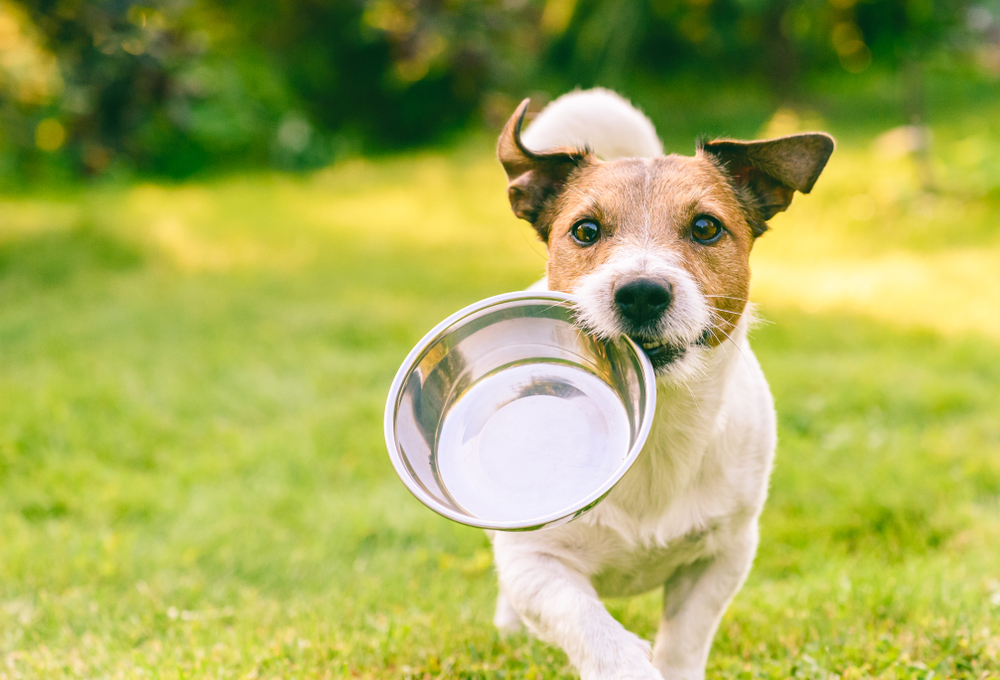
You just brought your first puppy home and you’re thrilled to embark on this new relationship! You want your puppy to grow into a healthy, happy dog. And you may have noticed that your excited furry friend is eager to please you! As eager as he seems, it will take time for him to know and abide by all your house rules. In the meantime, his exuberance could put him in harm’s way if you haven’t prepped your home. The pet counselors at Petland Cleveland put this article together to help you prep your home for your new puppy. By following the advice in this article, you can ensure your puppy will be safe while he matures.
We’ve also included a checklist so that you don’t forget about buying crucial supplies.
Let’s get started!
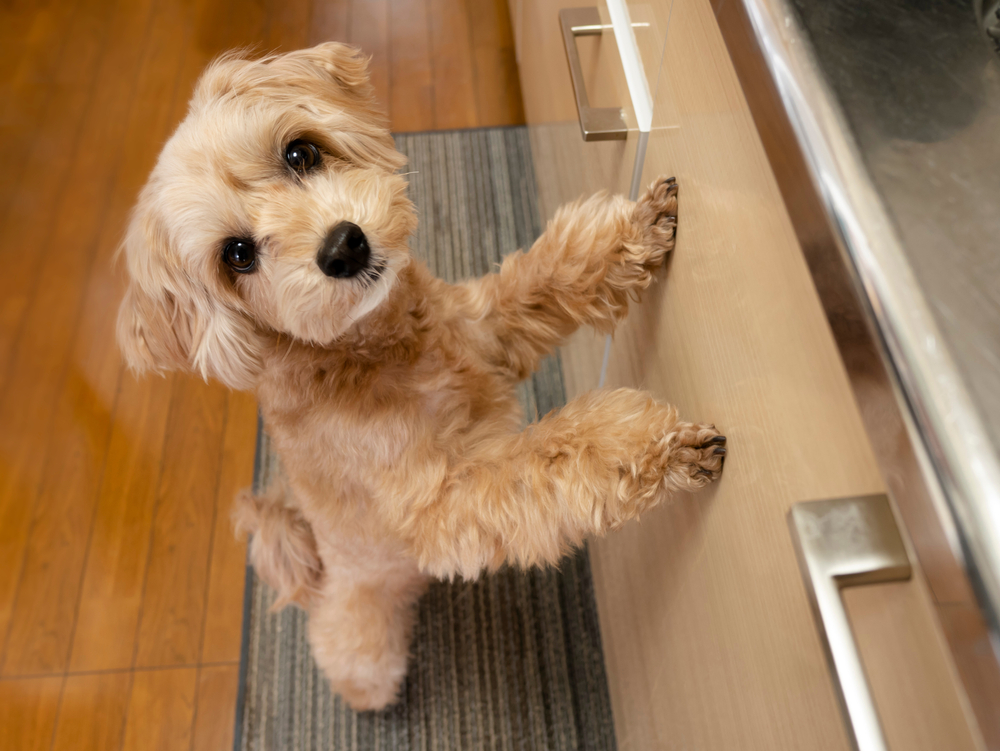
PUPPY-PROOFING YOUR HOME
Puppies have an instinct to “investigate with their mouths.” When a puppy is born into the world, his senses of smell and taste are the strongest. Even stronger than his eyesight. For this reason, the puppy will learn about his surroundings by licking, chewing, sniffing, and tasting everything
Even 8 – 10 weeks later when a new pet parent brings their first puppy home, the puppy will still be in the habit of investigating his new surroundings with his mouth. This could spell disaster if the home isn’t properly puppy-proofed. This is the first step to prep your home for a new puppy!
Remove Choking Hazards
Getting rid of all potential choking hazards should be the biggest priority. This cannot be overstated enough. You may even have to reconsider the bins and containers in your home. And if they have tops that are easy for a puppy to pry open, we recommend you invest in bins that close securely with a snap lock or twist-on cap.
The most common around-the-house choking hazards include coins, marbles, paper clips, rubber bands, string, yarn, ribbon, pantyhose, jewelry, hair elastics, scrunchies, hair accessories, screws, nails, nuts, bolts, toolkit items, and the list goes on. Even a balled-up, used paper towel that isn’t properly disposed of can wind up in your puppy’s throat when you aren’t looking.
Puppy-Proof Your Trash Receptacles
The next major area to prep your home for a new puppy is to puppy-proof your trash receptacles. The smells that waft out of household trash bins are irresistible to young puppies. Most common trash receptacles do not have lids that close and stay closed. The complex aromas of a typical garbage can, while repulsive to humans, will naturally remind your puppy of food, which means that if he gets into the trash, he’s going to try to eat what’s there.
Best case scenario, this will make a huge mess. But the worst case scenario could be fatal for your puppy. Many human foods are poisonous to dogs. You might be aware that chocolate is poisonous to dogs. But did you know that the list of poisonous food items includes grapes, avocados, onions, garlic, sugar-free gum with Xylitol, and most nuts? If you dispose of your gum in the trash and your puppy gets in there, it could mean a trip to the doggy E.R. and no one wants that!
Make sure that the trash bins you keep in the kitchen, bathrooms, tool shed, and any other area are mechanically able to close and stay closed. If not, then investing in new receptacles that stay closed is important.
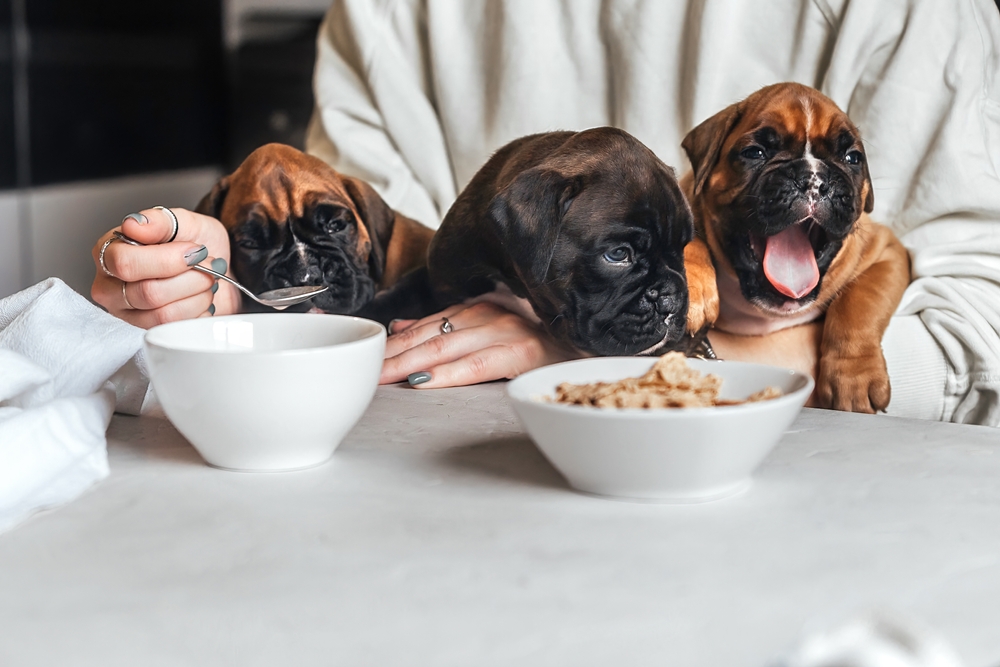
NEVER FEED YOUR PUPPY TABLE SCRAPS
Many human foods are poisonous to dogs, and so it’s also important not to feed your puppy table scraps. While your puppy is learning the house rules and practicing self-control, he might test boundaries and try to “steal” food from the table. This is why you should never leave your plate unattended at the table. Until your puppy is well trained, you’ll have to keep a watchful eye on your food to make sure your new furry friend doesn’t eat any hazardous table scraps.
While we’re on the subject of choking hazards, it’s important to note that some dog treats can pose a danger, such as rawhide chew treats and other “chewy” foods. It’s fine to let your puppy have a chewy treat, but always monitor him while he’s chewing until the food treat is gone. Don’t leave the room or else you’ll run the risk of him choking when you’re gone.
WHAT TO DO IF YOUR PUPPY BEGINS CHOKING
If your puppy does begin coughing, scratching at his mouth and neck, choking, gagging, or struggling with a chewy treat that gets caught in his throat, don’t panic or hesitate to act.
First, try to remove the object by hand by opening your puppy’s mouth and looking down the entire esophagus cavity. The object could be visually present, and if so, use your fingers to remove it.
Open Your Puppy’s Airways
If you’re unable to remove the object using your fingers, you can try using gravity by holding your puppy upside down, so that their head is facing down, and pat their back. You can also go a step further and perform the Heimlich Maneuver by kneeling behind your puppy, wrapping your arms around them and placing your fingers against the soft area just beneath their lower ribs. Then apply pressure in an “inwards and upwards” motion to that area of their stomach. This will cause your puppy to cough and retch and possibly vomit, all of which should dislodge the object.
If you cannot remove the object by using these methods, or if you cannot see anything in your puppy’s throat, then take your puppy to the vet right away. Never try to use a tool like pinchers, thongs, or pliers to remove a difficult object. You will risk injuring your puppy!
Important Warning Signs that Your Puppy Is Choking:
- Gagging sounds
- Excessive drooling
- Repeated swallowing
- Vomiting or regurgitation
- Restlessness
- Pawing at the mouth or throat
- Hacking cough
- Apathy or listlessness
- Loss of appetite
- Trouble breathing
Pay particular attention to the less obvious warning signs. If your puppy seems apathetic or loses his appetite, take him to the vet straight away. He could have a small object caught in his esophagus.
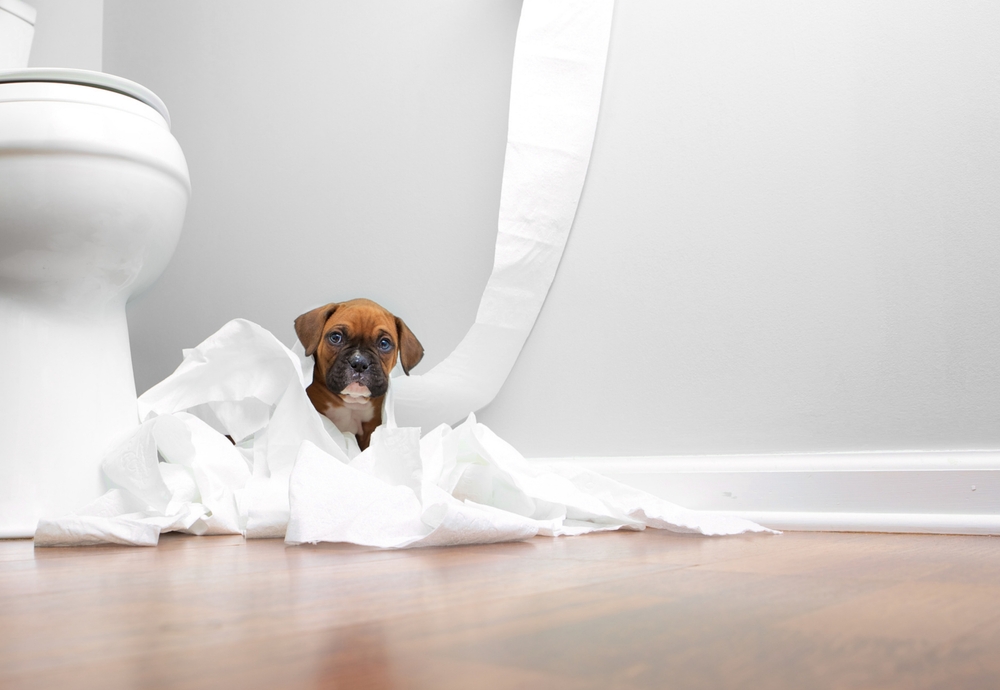
PUPPY-PROOF THE HOUSEHOLD ENVIRONMENT
The next important aspect when it comes to how to prep your home for a new puppy has to do with puppy-proofing. You’ll need to puppy proof the doors, windows, and both interior and exterior houseplants. Be sure to keep your doors and windows closed at all times. And make sure that the perimeter of your yard is fenced in. This way, your puppy won’t escape when he’s outside.
We also recommend that you reassess your house plant situation. Double-check to make sure your plants aren’t poisonous to dogs. And if they are, find new places for them to sit that are out of reach. Also, if you have standing potted plants in the house or outside, be warned that your puppy might try to play in the dirt—or poop there!—so you might want to move those plants to another location until your pup has matured.
IMPORTANT ITEMS TO HAVE AT HOME
Here are a few helpful checklists for you to reference as you go through your home. Puppy proof and make sure everything is perfect for your new furry friend.
Prior to Bringing Your Puppy Home, Buy These Items:
- Adjustable collar
- Comfortable leash
- Dog tags with your puppy’s name and current contact information
- An understanding of how to register and activate your dog’s microchip. And if your puppy won’t come microchipped, then you’ll need to buy this item
- Food and water bowls
- Healthy puppy food
- Wee wee pads
- Poop bags and holder
Additional Items to Have on Hand:
- Puzzle toys
- Puppy-proof chew toys
- Pooper scooper
- Harness
- Crate
- Dog bed
- Brush
- Grooming wipes
- Treats
- Dog toothpaste and toothbrush
- Puppy shampoo
- Enzyme spray for housebreaking accidents
- Carpet cleaner, also for housebreaking accidents
Important Contacts to Have On Hand:
- Veterinarian
- Dog trainer
- Dog walker
- Pet sitter
- Pet insurance information
- Dog groomer
- Emergency contact friends and family members
Are you ready for your very own Petland puppy? Check out our adorable breeds or stop in Petland Parma.
![[#261583-02] - Brown / White M Pomeranian Puppies for Sale](https://www.petlandcleveland.com/wp-content/uploads/2026/03/Cuteness-Loading-Image-1024x1024.png)
![[#261505-06] - Chocolate F Dachshund Puppies for Sale](https://www.petlandcleveland.com/wp-content/uploads/2026/08/DSC4645-copydach6104-1024x1024.jpg)
![[#26236-07] - Black / Tan F German Shepherd Dog Puppies for Sale](https://www.petlandcleveland.com/wp-content/uploads/2026/08/German.copy_-1024x1024.png)
![[#261440-03] - White / Black M Poodle Puppies for Sale](https://www.petlandcleveland.com/wp-content/uploads/2026/08/DSC4636-copypoodle6103-1024x1024.jpg)
![[#261341-02] - Black / White F Boston Terrier Puppies for Sale](https://www.petlandcleveland.com/wp-content/uploads/2026/08/bos-copy-1024x1024.jpg)
![[#261787-08] - Blue F Neapolitan Mastiff Puppies for Sale](https://www.petlandcleveland.com/wp-content/uploads/2026/08/DSC4712-copymas6114-1024x1024.jpg)
![[#261915-01] - Tri-Colored M Cavalier King Charles Spaniel Puppies for Sale](https://www.petlandcleveland.com/wp-content/uploads/2026/08/DSC4716-copycav6106-1024x1024.jpg)
![[#261755-01] - Red Fawn M Chihuahua Puppies for Sale](https://www.petlandcleveland.com/wp-content/uploads/2026/08/DSC4702-copychi6107-1024x1024.jpg)